

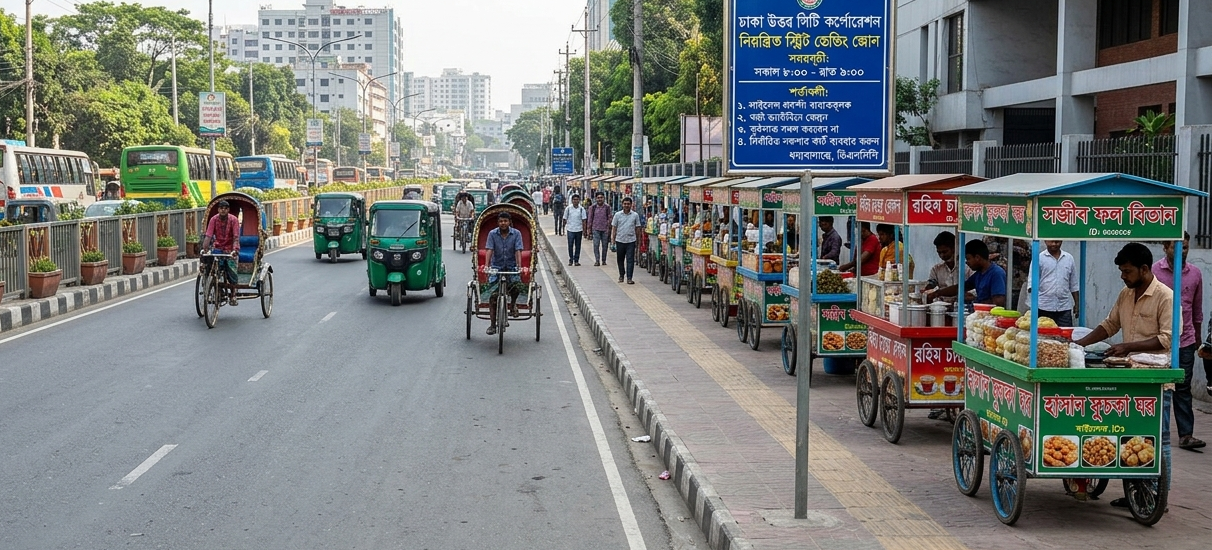
Street Shop Management in Bangladesh:
An Inclusive Policy Framework for Recognition, Control, Urban Order, and Revenue Growth
Street vending is not a problem to be removed—it is a reality to be managed. In rapidly urbanizing cities like Dhaka and Chattogram, street shops (hawkers) serve as a lifeline for millions of low-income consumers while providing employment for a vast informal workforce. However, the absence of a structured, technology-enabled management system has turned this sector into a source of congestion, disorder, and lost public revenue.
Most of the irregularities in Bangladesh are visible to the naked eye and many of us also know the remedies. We are especially aware of how different countries around the world are solving certain issues with the help of technology. First, most of us have assumed that this country will not change, that this country will continue like this. Which has left us mentally immobile. Second, no one wants to take responsibility, and those who do work do not move in the right direction. Meanwhile, we are tired of just raising our voices in vain. Even after we are given a roadmap of the entire process, we do not see the right steps.
Globally, cities that have succeeded—such as Singapore, Hong Kong, and Bangkok—did not eliminate street vendors; they organized, digitized, and regulated them. Bangladesh can adopt and localize these lessons to build a balanced system that protects livelihoods while ensuring urban discipline.
1. Legal Recognition and Digital Identity Framework
Formal Recognition of Street Vendors as Urban Economic Actors
A foundational shift is required in policy thinking—hawkers must be treated not as illegal encroachers but as legitimate contributors to the urban economy. Countries like India introduced legal frameworks (e.g., Street Vendors Act) to recognize vendors, reducing conflict and enabling governance. Bangladesh can adopt a similar recognition policy to bring vendors under a lawful structure.
Nationwide Digital Registration System
Every vendor should be registered through a centralized digital platform using National ID verification. This creates a unique identity for each vendor, eliminating duplication and enabling traceability. A structured database ensures that policymakers know who is operating, where, and under what conditions.
QR-Based Smart Identification System
Each registered vendor should receive a QR-coded smart ID card and QR Show Board for stall linked to their profile, zone, and payment status. This enables instant verification through mobile devices and reduces reliance on manual checks, which are often prone to corruption.
One Vendor, One License Policy
To prevent misuse and monopolization, each individual should be allowed only one registered vending identity unless special permission is granted. This ensures equitable access to urban space.
Unit-based classification:
Each area will have a hawker unit of 5 to 25 people. Which will be led by 1 to 3 hawkers. They will ensure that their group follows the rules and submits revenue. Everyone in the group will have to follow the rules at the same time.
Monitoring Agents
Area-based monitoring agents should be appointed to ensure cleanliness and compliance of hawkers and to stop extortion on them. By appointing agents, it will be possible to stop extortion, provide employment to the unemployed and maintain the entire system. They can work on the safety of hawkers as well as controlling traffic congestion and garbage on the roads.
2. Zoning, Spatial Planning, and Urban Design Integration
Scientific Zoning Based on Urban Dynamics
Cities must be divided into vending zones based on pedestrian flow, traffic density, commercial demand, and safety requirements. For example, Singapore relocated street vendors into organized hawker centers, ensuring both accessibility and order.
Three-Tier Zoning Model (Green, Yellow, Red Zones)
A structured zoning approach should be adopted:
- Green Zones: Fully permitted vending areas with infrastructure support
- Yellow Zones: Time-bound or restricted vending (e.g., evening markets)
- Red Zones: Strictly prohibited areas (hospitals, Corporate Office, major intersections)
This model balances economic activity with public safety.
Space Allocation with Unique IDs
Each vendor should be assigned a specific “Space ID,” ensuring that no vendor can arbitrarily occupy multiple locations. This prevents sidewalk encroachment and ensures fair distribution.
Integration with Urban Planning and Smart City Design
Zoning should not be temporary or ad hoc. It must be integrated into long-term urban planning frameworks, aligning with transport, drainage, and pedestrian infrastructure development.
3. Digital Revenue Collection and Financial Transparency
Daily Space Fee Model Instead of Informal Rent
A daily/ Monthly fee system, adjusted based on location value, ensures fairness and affordability. High-demand areas may have higher fees, while low-income zones remain accessible.
Digital Payment Ecosystem (Cashless System)
Payments should be made through mobile financial services, banking apps, or cards. This eliminates cash leakage, reduces informal collections, and builds financial transparency.
Real-Time Revenue Monitoring Dashboard
Municipal authorities should have access to dashboards showing daily collections, zone-wise revenue, and compliance rates. This transforms revenue management from reactive to proactive.
Global Insight: Formalization Drives Revenue Growth
In New York City, structured licensing and permit systems generate millions in annual revenue while maintaining strict compliance. Bangladesh can achieve many outcomes with a scaled digital system.
4. Public-Private Partnership (PPP) for Sustainable Implementation
Shared Responsibility Model
The government should retain policy, regulatory, and enforcement authority, while private partners handle technology development, operations, and maintenance. This ensures efficiency without compromising public control.
Revenue Sharing Mechanism
A transparent revenue-sharing model incentivizes private investment while guaranteeing steady income for city corporations.
Reduced Financial Burden on Government
By leveraging private sector expertise and funding, the government avoids large upfront costs while benefiting from advanced technology.
Global Example of PPP Efficiency
Cities like Bangkok have experimented with structured relocation and managed vending zones with private collaboration, improving urban order significantly.
5. Infrastructure Development and Vendor Facilities
Development of Organized Hawker Centers and Clusters
Instead of scattered street shops, vendors can be grouped into designated clusters with proper infrastructure—similar to Hong Kong cooked food centers.
Provision of Basic Utilities
Access to electricity, water, waste management, and sanitation facilities ensures hygiene and environmental sustainability.
Modular Stall Design and Urban Aesthetics
Standardized stalls improve the visual appeal of cities and enhance the customer experience, making vending areas attractive rather than chaotic.
Support for Mobility and Emergency Access
Properly planned vending zones ensure that emergency services, pedestrians, and vehicles can move freely.
6. Enforcement Mechanism with Social Inclusion
Balanced Enforcement Approach
Enforcement should not be purely punitive. It must combine regulation with inclusion, ensuring that vendors are guided rather than abruptly removed.
Digital Monitoring Tools for Field Officers
Officers can use mobile apps to scan QR codes, verify compliance, and issue digital warnings or fines. This reduces human bias and increases accountability.
Graduated Penalty System
Violations should follow a structured process: warning → fine → suspension → cancellation. This ensures fairness and due process.
Protection Against Harassment
Registered vendors gain legal protection, reducing extortion and informal payments.
Reviews and Ratings:
Buyers and the public will be able to give reviews, ratings to all hawkers or shoppers and can file complaints against them within the system. There will be a unit of the authority to resolve complaints who will respond quickly to these matters.
7. Data-Driven Governance and Smart Monitoring
Centralized Data System for Policy Decisions
Data collected from registration, payments, and enforcement should feed into a central system, enabling evidence-based decision-making.
Analytics for Demand and Revenue Forecasting
Authorities can identify high-demand zones, adjust pricing, and plan expansions based on real data.
Integration with Smart City Platforms
The system can be integrated with broader urban management tools, contributing to Bangladesh’s digital transformation agenda.
8. Training, Awareness, and Behavioral Transformation
Vendor Training Programs
Vendors should be trained in digital payment systems, hygiene practices, and customer service. This enhances professionalism and public trust.
Public Awareness Campaigns
Citizens should be encouraged to purchase from registered vendors, reinforcing compliance.
Cultural Shift Toward Orderly Urban Living
Over time, both vendors and citizens will adapt to a more disciplined urban environment.
9. Economic and Social Impact
Livelihood Protection and Inclusion
Formal recognition ensures job security and dignity for thousands of families.
Revenue Growth for Government
Even modest daily, weekly or monthly fees, when scaled across thousands of vendors, can generate substantial annual income.
Reduced Urban Conflict
Clear rules and digital systems minimize disputes between authorities and vendors.
Improved Public Safety and Mobility
Organized streets reduce accidents and enhance emergency response capability.
10. Implementation Roadmap for Bangladesh
Phase 1: Pilot Implementation (3–6 Months)
Launch pilot projects in selected zones of Dhaka to test registration, payment, and enforcement systems.
Phase 2: City-Wide Expansion (6–18 Months)
Expand across all zones within major city corporations, integrating zoning and infrastructure.
Phase 3: Nationwide Rollout (2–3 Years)
Extend the system to municipalities and smaller cities, creating a unified national framework.
Phase 4: Smart Integration and Optimization
Introduce advanced analytics, AI-based monitoring, and integration with other urban services. Bangladesh’s challenge is not the presence of street vendors—it is the absence of a structured system to manage them. By adopting a Smart Street Shop Management Framework, the country can transform an informal, chaotic sector into a regulated, inclusive, and revenue-generating ecosystem.
The experiences of Singapore, Hong Kong, and Bangkok demonstrate that success lies in planning, digitalization, and inclusive governance. With political will, institutional coordination, and technological innovation, Bangladesh can set a new benchmark in managing street vending.
The experience of sharing any new ideas or change outlines with government agencies in Bangladesh is very bad. First, they do new work within the old structure. As a result, the old structure does not match the new ideas and objectives and for the same reason its goals are not achieved.
Secondly, due to the thought of easy and quick implementation, new projects and programs are changed or implemented in such a way that it is successful as a paper project, in reality the people cannot enjoy any benefits from it and on the other hand the government incurs a huge expenditure.
Therefore, we have to come out of the traditional practices in the process of fundamental structural changes and implementation. We have to follow the models of other countries in the world and create a model suitable for Bangladesh.
Jahangir Alam Shovon
Policy Contributor
Picture: AI